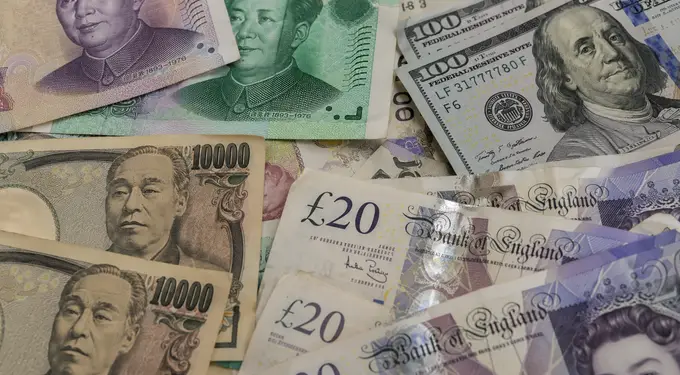

Dollar holds near six-week high as US data and Iran doubts lift demand

The US dollar held close to a six-week high on Friday as resilient US economic data and uncertainty over US-Iran talks kept demand for the greenback intact.
The dollar index traded at 99.24, little changed on the day and just below Thursday’s high of 99.515, the strongest level since April 7.
The move extended a period of dollar strength driven by firmer Treasury yields, safe-haven demand and expectations that US interest rates may need to remain higher for longer.
The euro slipped to $1.1613 from an opening level of $1.1683, leaving it under pressure after recent dollar gains.
Sterling was little changed at $1.3431, though it remained on course for a weekly rise of about 0.8%, despite recent volatility linked to political uncertainty in Britain.
US data support greenback
The latest US data added to the dollar’s support.
Weekly jobless claims fell, pointing to continued labour-market resilience, while a May manufacturing gauge rose to a four-year high.
The figures reinforced the view that the US economy remains strong enough to keep the Federal Reserve cautious on rate cuts.
That backdrop has helped the dollar outperform at a time when investors are also trying to assess the inflationary impact of elevated oil prices and Middle East tensions.
Tony Sycamore, market analyst at IG, said he was not convinced markets were much closer to a resolution between the US and Iran, suggesting there was still room for the dollar to strengthen if geopolitical risks persist.
Iran talks keep markets cautious
Currency markets remained sensitive to signals from US-Iran negotiations.
US Secretary of State Marco Rubio said there had been “some good signs” in talks with Iran, but added that major issues still needed to be resolved.
Tehran’s uranium stockpile and control over the Strait of Hormuz remain key points of contention.
The uncertainty matters for FX markets because any disruption around the Strait of Hormuz could keep oil prices elevated, feed inflation concerns and support the dollar through both safe-haven flows and higher rate expectations.
For now, investors appear reluctant to price in a durable diplomatic breakthrough until there is clearer evidence of progress.
Yen weakens as intervention watch builds
The Japanese yen remained under pressure, trading around 159.09 per dollar and leaving traders alert to possible intervention from Tokyo.
The currency was 0.1% weaker on the day and has given back more than half of its post-intervention gains.
That has increased speculation that Japanese authorities may step back into the market if yen weakness accelerates.
Short-term direction in the yen is likely to remain tied to broader FX sentiment, the dollar’s momentum and official comments from Japan.
Policymakers have signalled that there is no fixed limit on the scale or frequency of intervention if disorderly moves threaten market stability.
Emerging Asia faces oil-driven pressure
Emerging Asian currencies also remained under strain as higher oil prices and a firm US dollar increased pressure on external balances.
Indonesia has moved to support the rupiah, with the government requiring natural resource exporters to place 100% of their export proceeds in state-owned banks from June 1.
The measure is aimed at boosting onshore US dollar supply and stabilising the currency.
Nigel Foo, head of Asian fixed income at First Sentier Investors, said the move was designed to intervene directly in the currency market by increasing domestic dollar liquidity.
He added that a currency’s value reflects a country’s underlying fundamentals, which in Indonesia’s case have deteriorated.
Outlook remains tied to oil and policy
For now, the dollar’s advantage reflects a combination of US economic resilience, uncertainty over Middle East diplomacy and pressure on Asian currencies from elevated energy prices.
Markets will continue to watch US-Iran talks, oil prices and Japanese intervention risks for direction.
Until there is clearer progress on the diplomatic front, the US dollar is likely to remain the main beneficiary of uncertainty across currency markets.
The post Dollar holds near six-week high as US data and Iran doubts lift demand appeared first on Invezz